

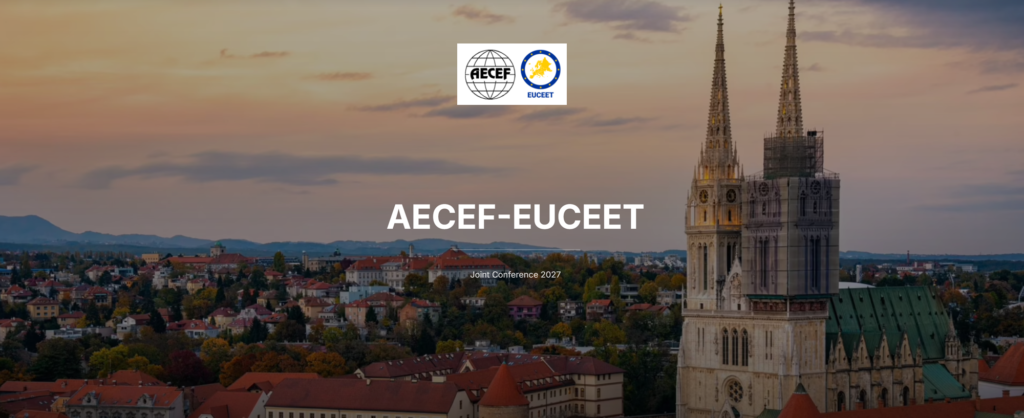
AECEF-EUCEET Joint Conference
Theme of Conference:
Civil Engineering Education for the Green and Digital Transformation
22-23 April 2027
University of Zagreb
Croatia
Welcome to the AECEF–EUCEET Joint Conference 2027, to be held in Zagreb on 22–23 April 2027. Jointly organised by AECEF and EUCEET, this conference will bring together colleagues, researchers and academic leaders interested in the future of Civil Engineering education in Europe. Under the theme “Civil Engineering Education for the Green and Digital Transformation”, the event will provide a forum to exchange experiences, discuss current challenges and share innovative approaches in teaching, learning and curriculum development. The conference will also offer an opportunity to strengthen cooperation between institutions and to reflect collectively on the contribution of Civil Engineering education to Europe.

Prof. José Manuel Pinto Ferreira Lemos passed away on 29 March 2025. He was Honorary President of AECEF since 11 May 2023, President between 2017 and 2021 and member of the Board between 1995 and 2017. These messages from Board and AECEF members were expressed in the Board meeting on 11Apr25:
“- I was very sorry to read that Professor Lemos had passed away. He was a great man and I respected him for his contribution to the AECEF development and activities and for his support to cooperation among civil engineering faculties. R.I.P..
– Very sad news. Please pass on my condolences to the family.
– With great sadness, I received the news of José’s passing. I had the privilege of knowing him since the early years of AECEF’s founding, serving alongside him on its Board for many years that followed. I will always remember his exceptional personality and sharp intellect.
– I am also very sorry to hear Prof. Fereira Lemos has passed away. He was a nice man and we had a good time cooperating with him.
– I am very saddened to hear about prof. Lemos’s passing. I am happy I had a chance to meet him. He was a very good and kind person. My thoughts are with his family and everyone who had the privilege of knowing him.
– It is really very sad. I remember him for many, many years with great attention.
– This is such a shock! I have known Prof Lemos for most of my working life, and he was always so committed and kind to AECEF/EUCEET friends. And he was still the usual engaging Prof Lemos when we met in Pisa recently. A big loss to AECEF and FEUP, and the Ordem, I am sure – and you too, Alfredo, you have known Prof Lemos longer and better than all of us! A sad time for the Association.
– I am so sorry to hear that. He was a great man and a remarkable engineer.”
From the Ordem dos Engenheiros (https://www.ordemdosengenheiros.pt/pt/):
It is with deep regret that the National Board of Directors learned of the passing of Engineer José Ferreira Lemos, a distinguished member of the Order of Engineers, an Association in which he held various positions, including that of National Vice-President. Throughout his career, José Ferreira Lemos contributed significantly to engineering and to the appreciation of the profession, leaving a legacy of dedication and excellence. José Ferreira de Lemos held a bachelor’s and doctoral degree in Civil Engineering from FEUP (Faculty of Engineering of the University of Porto), where he was Director of the Department of Civil Engineering and President of the Pedagogical Council. Having dedicated a large part of his professional life to the area of hydraulic works, he chaired the National Technical Commission for Risk Management, was a member of the Higher Council for Public Works and Transport, and was a member and President of AECEF. A retired Full Professor at FEUP and a Member of the Board of Directors of the Order of Engineers, he was part of the Portuguese National Commission for Large Dams and the Dam Safety Commission.
From the Commission of Large Dams (CNPGB – https://cnpgb.apambiente.pt/):
It is with great sadness that we at the Portuguese National Commission for Large Dams received the news of the passing of Professor José Ferreira Lemos, a long-time member of the CNPGB. Professor Ferreira Lemos was a figure of great importance in civil engineering in Portugal, contributing significantly to the field of hydraulic works and dams in particular. During his career, Professor Ferreira Lemos held several important positions, including that of National Vice-President of the Order of Engineers, and was a highly respected tenured professor known for his professional rigor and personal relationships. His legacy of dedication and excellence will continue to inspire future generations of engineers.
Excerpts from his interview after his last class (Última Aula):
Last lecture was entitled “What I Learned. What I Taught. What I Stood For.” What have you learned in these decades, both as a student and later as an integral part of the Faculty of Engineering?”
What I learned… I learned a lot in college, particularly regarding the physical meaning of the main operators. I also learned how to deal with students and professors. I learned to know my limitations, but to better understand the limitations of others, advice given to me by my father. I think I also always tried to have a humanist companion among colleagues and engineers. I always tried to know how to be in my profession as a university professor, where I had hundreds of students and colleagues to interact with every day. “I learned to know my limitations, but to better understand the limitations of others”. Regarding my classes, I always tried to give the physical meaning of things and not just dump subject after subject for the students to grasp little. What I taught, I taught in substantial quantity, but always accompanied by the application of these concepts. What did you most enjoy teaching? The courses I taught were related to hydraulic engineering, hydraulics, and geotechnics. Concerning projects there was a phase in my life, in recent years, when age was starting to take its toll, and I dedicated myself more to the international promotion of the faculty with AECEF participation, for instance. But I participated in very interesting projects, such as the Crestuma dam, foundations for wind turbines, special structures like the slope of the Palace, although few people like that concrete structure on Rua da Restauração. I also participated in the Francos Interchange, the Boavista Interchange, the access to the Freixo Bridge, the tunnel that leads to the Soares dos Reis Museum… that’s just in our city. Outside of Porto, I participated in numerous studies of hydroelectric power plants, communication routes… My last class is already overdue, because I retired on 31 July 2009, when the school year ended. I always tried to avoid giving my last class, because in my opinion, to give one you have to meet three conditions. The first is to be a career professor, and I am. The second is to be a tenured professor… I am. The third is to be 70 years old… I’m not (laughs). I avoided giving this last class in January, February, March… and in May I couldn’t escape it anymore, because it seems that people are retiring earlier and earlier, and the excuse of being 70 wasn’t a very strong one. Therefore, I will give my last class tomorrow, with great pleasure. I’ve been teaching since 1970, I’ve never had any time off work, never had a sabbatical, I’ve always really enjoyed teaching. Also, since I had a very rich professional career, I passed on to the students certain situations that I experienced and I’m sure I gave very pleasant classes.

Obituary
prof. Ing. Jiří Witzany, DrSc., dr.h.c.
On 5.1.2026, Professor prof. Ing. Jiří Witzany , DrSc., dr.h.c passed away at the age of 84.
Professor Jiří Witzany was among the leading experts in the theory and design of building structures. As an author or co-author, he designed and experimentally as well as practically verified a number of new building systems and structures, such as industrially manufactured buildings made of steel spatial units, a prefabricated column system with slab floor construction, and many others. He also made a significant contribution to the development of the theory of designing prefabricated structures and the reconstruction of historic buildings. He proposed the basic variants for the restoration and repair of Charles Bridge and was involved in many other major projects.
In December 1989, he was elected the first post-revolution dean of the Faculty of Civil Engineering at the Czech Technical University in Prague. He held this position for three terms and implemented a number of fundamental changes in the organization of the faculty. He initiated the establishment of study programs in Environmental Engineering and in Economics and Management, and founded the program in Building Construction and Architecture.
In 1999 and again in 2002, the Academic Senate of the Czech Technical University elected Professor Witzany as Rector of the Czech Technical University. During his tenure, the number of students and doctoral candidates, including international students, increased significantly, and the university’s research activities were further strengthened. Among the outstanding results of his efforts were the establishment of the Faculty of Biomedical Engineering, the Institute of Theoretical and Experimental Physics, and the commencement of construction of the new building for the Faculty of Architecture.
Professor Witzany served in a number of important academic institutions, including the Government Council for Research, Development and Innovation, and also as an advisor to the Prime Minister on science and research. In 1992, he founded the Association of European Civil Engineering Faculties (AECEF) and was repeatedly elected its president (for 25 years). This association brings together many European universities offering civil engineering education. He also founded and was actively involved in the activities of the November 17 Foundation, which financially supports students with outstanding academic results from socially disadvantaged backgrounds, as well as the Josef, Marie and Zdeňka Hlávka Endowment Fund and other non-profit organizations. His significant contribution to educational and scientific development was recognized by numerous medals and awards; among others, he received the First Degree Medal of the Ministry of Education, Youth and Sports of the Czech Republic, the Silver Medal of the Senate of the Czech Republic, and other distinctions.

nEWSLETTERS
2026
Mar-Apr
Op zoek naar de beste free spins zonder eindeloos te zoeken? Bezoek Skyhills casino en vind altijd de meest recente casinobonussen en gratis spins.
Speel mee met onze live dealers en ervaar de authentieke spanning van een echt casino zonder cruks, terwijl je geniet van spannende spellen en dynamische interacties in real-time.